Students have returned to schools across the nation. Five years removed from the COVID-19 pandemic, the challenges of such a tumultuous time for students and teachers alike can feel more like a lifetime ago. While a new school year marks a fresh start for many, it can be the opening to a challenging year from a risk management perspective for institutions.
A longitudinal study of student-on-teacher violence K-12 schools compiled by Gallagher Bassett based on proprietary claims data reveals a trend that is worth monitoring: assault claims in K–12 schools have moved beyond a simple rebound story.
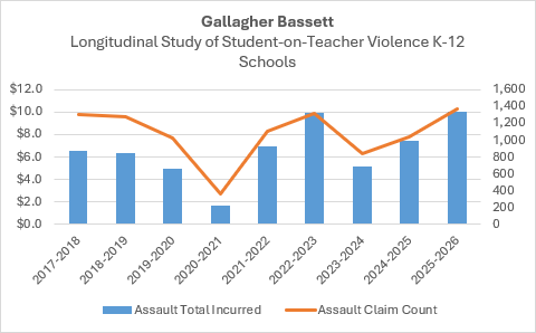
During the 2025-2026 school year, the claim count reached 1,378, up 32.5% from the 2024-2025 school year and 5.2% above 2017-2018—while total incurred rose to $10.0 million, 51.5% above the starting point of the analyzed period. Additionally, this change represents a 32.5% increase from the 2024-2025 school year, when 1,040 claims generated $7.4 million in incurred costs.
The divergence is partly a severity story: average incurred per claim increased from $5,038 to $7,257, a 44% rise. Assaults now represent 19% of all claim volume, but 11% of total incurred, suggesting a frequency-heavy risk even as aggregate cost reaches a record.
The pandemic-year trough and the 2023-2024 pullback caution against treating the path as linear. For risk managers, the next test is whether higher frequency reflects exposure, reporting, or prevention gaps, and whether severity is being driven by medical, indemnity, legal, or claim-maturity effects.
Based on this analysis, incidents are being reported more often, and the injuries themselves appear to be increasing in severity.
That distinction matters. For years, educator assaults were widely believed to be underreported. In the years following the pandemic—and after several high-profile school violence incidents—educators, unions, and school administrators have placed greater emphasis on honest, timely reporting.
The National Education Association and the American Psychological Association have also elevated the issue, publishing joint resources in November 2025 that synthesize national survey data and recommend strategies for improving educator safety, school culture, and well-being. Their work reinforces an important point for risk leaders: without reliable incident reporting protocols, school systems cannot understand the baseline level of violence, identify patterns, or justify resources for prevention.
Severity Is Changing the Conversation
Claims are growing more complex and increasingly involve longer periods away from work, more orthopedic, facial, and bodily injuries, and a growing psychological component. That psychological overlay is significant. An assault in a classroom can leave an educator managing not only physical pain, but anxiety, fear, trauma symptoms, and uncertainty about whether returning to the same environment is safe.
Risk Management Starts Before the Claim
The challenge for schools is that no single intervention will solve the problem. Districts are operating amid constrained budgets, larger class sizes in some communities, staff shortages, evolving student behavioral needs, and heightened parent and community expectations. The most effective approach is likely to be incremental and layered.
The first step is better coding and analysis on the claims side. Districts need to know whether an assault involved a student with identified special needs, whether warning signs existed, whether the educator was working alone, whether staffing levels were adequate, and whether prior behavioral interventions had been attempted. That information is not about assigning blame; it is about matching resources to risk. If a student needs additional support, the district needs a way to see that need clearly and respond before an employee is injured.
De-escalation training is another practical tool. Techniques adapted from law enforcement and first responders are increasingly being translated into school-appropriate models that help educators identify early warning signs, reduce tension, and seek help before an interaction turns physical. Workers’ compensation data captures only the incidents that become claims. In many cases, those claims are preceded by lower-grade behaviors: verbal aggression, threats, disruptive conduct, or minor physical contact. Training educators and support staff to recognize those patterns can help schools intervene earlier.
Districts also need to connect workers’ compensation data with general liability, student services, security, and human resources. A classroom assault can trigger a comp claim, but it may also raise questions about prior warnings, supervision, accommodations, discipline, parent communications, and the district’s duty to provide a safe workplace.
Technology, Socialization, and School Climate
The post-pandemic period has added another layer of difficulty. Students now in middle school and high school spent formative years in disrupted learning environments, with more virtual instruction, less in-person socialization, and greater reliance on digital interaction. While educators and psychologists are still studying the long-term effects, districts are already managing the practical reality: some students may have missed key social and emotional development opportunities, and those gaps can surface in classrooms.
Cell phones and personal devices are also drawing renewed attention. In July 2026, Illinois signed legislation requiring public school districts to develop bell-to-bell cell phone policies, restricting access to personal devices during the school day, with full implementation expected for the 2027-2028 school year. Supporters argue that distraction-free classrooms can improve student engagement, reduce disruption, and help rebalance the learning environment in favor of teachers and instruction.
For risk managers, device policies should be viewed as part of a broader school climate strategy rather than a stand-alone safety solution. Technology can contribute to distraction, conflict, bullying, and impulsive behavior, but removing phones will not resolve staffing shortages, behavioral health needs, or inadequate intervention systems. Still, it may reduce one source of classroom volatility and create space for stronger student-teacher engagement.
The Way Forward
The dynamic nature of educator assault claims should be a signal for school leaders, public entity insurers, and claims administrators to take proactive steps to mitigate risk. Better reporting is not bad news; it is the foundation for better prevention. Once districts understand where incidents are happening, who is involved, what injuries are occurring, and which interventions are missing, they can make more informed decisions about staffing, training, supervision, and claims response.
For workers’ compensation programs, the priority is twofold: prevent avoidable injuries and respond decisively when serious injuries occur. That means coordinating early medical care, recognizing psychological components, supporting modified duties where appropriate, and using catastrophic injury strategies when losses are severe. It also means treating teacher safety as an enterprise risk issue, not simply a claims statistic.
As claim counts and costs rise, the districts that make the most progress will be those that combine transparent reporting, targeted resources, de-escalation training, stronger school climate policies, and sophisticated claims management. The goal is not only to reduce workers’ compensation costs, but to keep teachers safe, keep classrooms stable, and help injured educators return to work with confidence.
About the author
Greg McKenna is the national practice leader, public sector at Gallagher Bassett. gregory_mckenna@gbtpa.com