Early in my career, I realized something profound about the difference between building a project and litigating one. In construction, we have a standardized set of documents—plans, specifications, RFIs, change orders—that define the physical reality of the building. If you do not know how to read a set of structural drawings, you should not build the building.
The legal world works the same way. Just as there are fundamental construction documents that define a project, there is a parallel set of legal documents that define a dispute.
For many professions today, including architects, engineers, and lawyers, there are evolved and engineered collections of practices that, when mastered and used in a disciplined way, result in predictable and desirable outcomes. I call these collections the “boring but important fundamentals.”
Legal document literacy is the ability to read, understand, and interpret the instruments of civil litigation. It is a crucial skill for any construction professional presented as an expert witness or consultant. If you are hired to investigate a window leak but you don't understand what a “cross-complaint” is, you might miss the fact that you are not only defending your client, but also you are also required to make a case against another party.
The following is a guide to the 24 most important legal documents you will encounter, defined in plain English, with specific advice on how to use them to do awesome work.
1. Complaints
What it is: The complaint is the “Big Bang” of a lawsuit. It is the initial document filed by a plaintiff to start the legal process. It sets forth the allegations (claims) against the defendant and states the relief (usually money) being sought.
Why it matters: In construction, this is where the property owner or developer first tells their version of "what went wrong." It frames the entire scope of the dispute. In our work there is often a report from an opposing expert that contains all or most of the allegations; what we call issues. It is less common for the complaint (or amended complaint) to contain additional allegations that we need to address. If we don't analyze the complaint, then we may not have 100% of the issues that we must respond to.
Action item: Read the complaint immediately. Highlight the specific allegations that relate to your trade or expertise. If you are a roofer and the complaint only mentions plumbing leaks, call your attorney client immediately to clarify your scope.
2. Answers
What it is: The formal written response filed by a defendant after being served with a complaint. It admits or denies the allegations and asserts affirmative defenses (reasons why they aren't liable even if the facts are true).
Why it matters: This is the first time the other side gets to speak. It tells you what the fight is going to be about. Are they denying the leak exists? or are they admitting the leak but blaming lack of maintenance?
Action item: Look for the affirmative defenses. If the answer asserts the “statute of limitations,” your investigation needs to focus heavily on when the damage occurred, not just what the damage is.
3. Cross-Complaints and Third-Party Complaints
What it is: These are lawsuits filed by a defendant (someone who has already been sued) against someone else. The key difference is who is being targeted. A cross-complaint (or cross-claim) is typically a lawsuit against an existing party in the case (like a co-defendant). A third-party complaint is a lawsuit that drags a stranger (a new party) into the litigation.
Note: In some jurisdictions like California, the term “cross-complaint” is a catch-all that covers both scenarios.
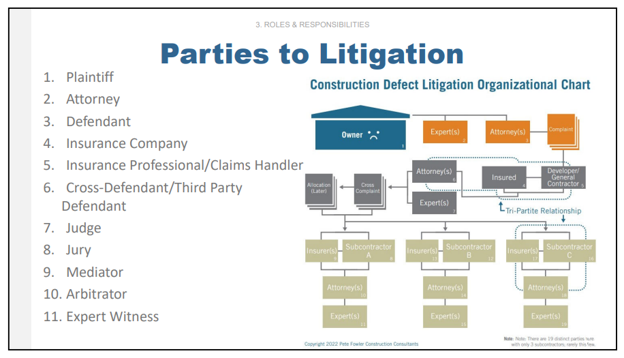
Why it matters: In construction litigation, this is how the food chain of liability is built. The homeowner sues the general contractor (GC). The GC then files a cross-complaint against the subcontractors (co-defendants) for indemnity (“If I have to pay, you have to pay me back”). If the window subcontractor believes the window product was defective, they might then file a third-party complaint against the window manufacturer (a new party), expanding the circle of litigation.
The war story: We worked for a framing subcontractor who was sued via cross-complaint by the GC. The GC alleged the framer failed to install the windows correctly. However, the framer’s contract excluded window installation—that work belonged to a different sub. Because we analyzed the cross-complaint early, we helped prove our client wasn't even responsible for the scope in question, getting them dismissed months earlier than expected.
Action Item: Map out the parties immediately. Create an organizational chart (see example in the chart below) to show who is suing whom. If you suspect a product failure (like a leaking window or defective pipe), advise your client early that a third-party complaint against the manufacturer might be necessary. This triggers specific evidence preservation protocols you must follow to prove it was the product, not the labor, that failed.
4. Amended Complaints or Pleadings
What it is: A revised version of the initial filing. Litigation is fluid; as experts investigate and uncover new defects, lawyers update the paperwork.
Why it matters: The scope of your work can change overnight. A first amended complaint might add a claim for fraud or add a new building to the lawsuit.
Action item: Always check the date. Ensure you are working off the operative pleading. I have seen experts write reports addressing issues that were dropped from the lawsuit six months prior because they were working off the original complaint.
5. Discovery requests (The umbrella)
What it is: Discovery is the overarching legal process where parties exchange information. The actual discovery requests are the specific documents used to execute this process, including interrogatories (questions), depositions (oral testimony), and requests for production of documents (RFPD).
Why it matters: You cannot analyze what you do not have. This phase is the primary tool used to gather the facts of the case.
Action item: Understand that these requests are not separate silos; they work together. We use documents found in an RFPD (item 6 in the above chart) to ask better questions in a deposition.
6. Requests for Production of Documents (RFPD)
What it is: A formal request asking a party to provide specific documents, electronic files, or physical evidence.
Why it matters: David Heemann, a seasoned construction attorney, calls this “probably the most important aspect of a construction case.” It is the legal “fishing expedition” where we get the training manuals, bid sheets, contracts, change orders, and internal emails that prove the case.
Action item: Help your attorney draft these. They know the law, but they do not know that a daily log is different from a superintendent’s diary. Give them a specific shopping list of construction documents to ask for.
7. Interrogatories
What it is: A specific type of discovery request consisting of written questions that must be answered in writing under oath.
Why it matters: These lock the parties into a story. However, many courts limit the number of questions you can ask (often to 25 or 35). This means attorneys must be creative and comprehensive, crafting questions that gather the most information in the limited space available.
The war story: In a slip-and-fall case, the plaintiff stated in an interrogatory that they “tripped over a one-inch lip in the concrete.” When we went to the site, we measured the lip at 1/4 inch. That written answer, combined with our physical measurement, destroyed their credibility before a deposition was ever taken.
Action item: Review the interrogatories early. If the number of questions is limited, ensure your technical questions make the final cut before the attorney files them.
8. Depositions
What it is: Sworn, out-of-court oral testimony of a witness, reduced to a written transcript.
Why it matters: This is the most critical performance event prior to trial. It is where the facts are locked in.
Action item: Help counsel prepare by draft technical questions for them to ask the opposing experts. Also, encourage the use of exhibits. Showing a witness a photo or a daily log during a deposition forces them to react to hard evidence rather than just giving vague answers.
9. Declarations
What it is: A written statement made under penalty of perjury. Unlike a deposition, there is no cross-examination (yet).
Why it matters: Experts often write declarations to support motions. It is a "mini-report" used to convince the judge to do something (like dismiss a case or allow destructive testing).
The war story: I had to write a declaration explaining why we needed to cut open a stucco wall. The homeowner opposed it as “invasive.” I wrote a detailed, step-by-step declaration explaining that, without opening the wall, we could not see the flashing, and without seeing the flashing, we could not determine liability. The judge cited my declaration in the order granting the testing.
Action item: When drafting a declaration, be precise. You are swearing to it. If you exaggerate, it can be used to impeach you at trial.
10. Expert Designations
What it is: A formal notice filed by attorneys identifying who their expert witnesses will be. In many jurisdictions, this is part of a broader witness disclosure filing that lists everyone who might testify, including party witnesses (the owner, the contractor) and non-party witnesses (the inspector).
Why it matters: This is the menu of talent. It tells you exactly who you are fighting against.
Action item: Read the designation for the opposing expert immediately. Google them. Find out what they have written, where they have testified, and if they have ever been disqualified. If the designation says they will testify about “standard of care,” but they are not a licensed contractor, you have a target for cross-examination.
11. Case Management Orders (CMO)
What it is: An order (or series of orders) issued by the judge to set the schedule and procedural rules.
Note: In some jurisdictions, this is called a case scheduling order. It is the same thing; different name. In complex construction cases, the CMO is the project schedule and the rule book combined. There may be multiple CMOs issued over the life of a case (e.g., CMO #1, CMO #2) as the litigation phases evolve.
Why it matters: It dictates the heartbeat of the case. It establishes the "discovery cut-off" (the hard stop for gathering evidence), the deadline for expert reports, and the trial date. Crucially for construction pros, the CMO often contains specific destructive testing protocols — rules that dictate exactly how much notice you must give before cutting open a wall, who can be present, and how the evidence must be stored.
Action item: Read the CMO immediately upon receipt to find the testing protocols. If the CMO says you must provide 72 hours’ notice before inspection and you only give 24, your evidence can be thrown out. Put the deadlines in your calendar with lead time. Missing a CMO deadline can result in testimony being excluded; this could be a career-ending mistake.
12. Subpoenas
What it is: A court order commanding a person (or company) to appear to testify or produce documents.
Why it matters: We use these to get records from third parties who are not in the lawsuit—like the city building department, the material supplier, or the previous owner.
Action item: If you need documents that are not in the file (like the original lumber invoices), tell your attorney to subpoena the lumber yard. They often will not think to do it unless you ask.
13. Protective Orders
What it is: A court order limiting the disclosure of sensitive information.
Why it matters: In construction, this protects trade secrets, financial data, or proprietary manufacturing processes.
Action item: If you receive documents marked “CONFIDENTIAL - SUBJECT TO PROTECTIVE ORDER,” do not email them to your sub-consultants or show them to your friends. You can be held in contempt of court. Treat these files like radioactive material.
14. Motion for Summary Judgment (MSJ)
What it is: A request asking the court to decide the case (or part of it) without a trial because there are no disputed material facts.
Why it matters: This is the knockout punch. The defense says, “Even if everything the plaintiff says is true, we still win because the statute of limitations has passed.
Action item: You may be asked to write a declaration to support or oppose an MSJ. Your job here is not to argue the law, but to clarify the facts so the judge can apply the law.
15. Summary of Undisputed Facts
What it is: A document filed with an MSJ listing specific facts that the moving party claims are not in dispute, citing evidence for each.
Why it matters: This is the scorecard for the MSJ.
Action item: Review this list carefully. If the other side lists, “The roof was completed in 2010” as an undisputed fact, but you have a permit showing it was finished in 2012, you need to flag that immediately. That single fact could save the case.
16. Mediation Briefs
What it is: A written summary of the case submitted to a mediator (a neutral negotiator) prior to a settlement conference. It outlines the facts, the legal arguments, and the damages, but it is written with a specific goal: to persuade the other side (and the mediator) that settling is better than fighting.
Why it matters: Confidentiality. Unlike almost every other document on this list, mediation briefs are privileged. They often contain sensitive admissions or bottom-line settlement numbers. This is often the first time an expert sees the attorney's full narrative of the case in one place.
Action item: Read this to understand the leverage points your attorney is using, but treat it like a state secret. Help your client improve this document. Never forward it without permission.
17. Trial Briefs
What it is: Written arguments submitted to the judge before trial. It is a formal roadmap of the case, outlining the legal theories, the list of witnesses, and the evidence that will be presented.
Why it matters: This is the script for the trial. It tells the judge what the attorney intends to prove and, more importantly, what they believe the law requires. If the mediation brief is a sales pitch, the trial brief is a technical manual for the judge.
Action item: Read this to align your testimony with the final legal strategy. You need to know if the attorney has dropped certain claims or focused entirely on others so you do not waste time on the stand talking about issues that are no longer part of the case.
18. Motions in Limine (Pre-Trial Motions)
What it is: A motion filed before the trial starts (limine means “at the threshold”) asking the judge to prevent certain evidence from being presented to the jury.
Why it matters: These are the rules of engagement for the trial. A successful motion in limine might ban the opposing expert from mentioning that your client has insurance, or prevent them from relying on a building code that wasn't in effect when the house was built.
Action item: Ask your attorney if there are any limine rulings that limit what you can say on the stand. You do not want to be the expert who accidentally blabs about “insurance” and causes a mistrial.
19. Jury Instructions
What it is: The specific rules of law given by the judge to the jury to guide their deliberations.
Why it matters: These instructions define complex concepts like standard of care, negligence, and breach of contract in plain English.
Action item: I actually recommend experts read the standard jury instructions for construction defects before writing their reports. It teaches you the language the jury will be using to grade your client's homework. If you use the same terminology (“reasonably prudent contractor”), your testimony will resonate more.
20. Verdicts
What it is: The formal decision made by a jury.
Why it matters: It determines the winner, the loser, and the money.
21. Judgments
What it is: The final order entered by the court based on the verdict. This is the piece of paper that creates the legal debt.
Why it matters: Until there is a judgment, it is just talk. The judgment is what allows the winner to send the sheriff to collect.
22. Post-Trial Motions
What it is: Requests made after the verdict to change the outcome (e.g., asking for a new trial).
Why it matters: The fight is not over when the jury leaves.
Action item: You may be asked to provide an affidavit explaining a technical aspect of the trial testimony to support these motions. Keep your files organized even after the trial ends.
23. Appeals
What it is: A request to a higher court to review the trial court’s decision for legal errors.
Why it matters: Appeals focus on the law, not the facts. However, appellate judges read the trial transcript.
Action item: This is why your deposition and trial testimony must be clear. Years later, an appellate judge you will never meet will read your words. If you were vague or sarcastic, it will look terrible on paper.
24. Settlement Agreements
What it is: A contract to resolve the dispute and end the lawsuit voluntarily.
Why it matters: This is how more than 98% of construction cases end. It defines who pays, when, and the scope of the "release."
Action item: Ensure the settlement covers everything. I have seen cases settle at mediation, only for the parties to keep fighting for weeks over the details in the agreement.
The legal system runs on documentation. While construction professionals live in a world of drawings and physical materials, our attorney clients live in a world defined by these twenty-four documents.
If you want to be a “good expert”—one who is a true asset to the team rather than just a vendor—you must be literate in their language. You don't need to be a lawyer, but you need to know that an Interrogatory is a question you have to answer, and a subpoena is a command you have to obey.
By mastering this list, you move from being a spectator in the legal process to being an active, strategic participant. You can anticipate what the attorney needs before they ask. You can spot the traps in a Cross-Complaint before they spring. And ultimately, you can help your client make the smart, informed decisions that lead to a drama-free resolution.