For several years, there have been discussions in the legal field about the effect of juror anger on damage awards in civil litigation. What was once a concept that attorneys only needed to worry about in cases involving punitive damages has expanded into the realm of compensatory damages. In a time of constant, headline-grabbing civil-litigation verdicts, it makes intuitive sense for individuals to want to identify the primary drivers behind these large damage awards.
To help inform our opinions, we conducted a study in 2024 (discussed here in CLM Magazine) that set out to examine the relationship between anger toward the defendant and compensatory damages. We wanted the data to drive our conclusions; not anecdotal evidence or gut feelings. Our first study showed several key findings:
- The correlation, or association, between anger toward the defendant and compensatory damages was weak.
- Only 9% of the variance (i.e., how far a set of numbers is spread out from their average value) in compensatory damages can be explained by juror anger—leaving 91% unaccounted for. In other words, 91% of the reason(s) for outsized verdicts was driven by something other than anger.
- Once you take plaintiff evidence strength into consideration, juror anger is no longer a significant predictor of compensatory damages.
Despite these findings, we believe that more research is needed to further understand the relationship between juror anger and compensatory damages. This paper aims to build on our earlier study with a larger sample of cases. We will re-examine our original hypotheses:
- Anger toward the defendant would be positively correlated to jury damage award amounts.
- The strength of this correlation would not be strong.
- Anger would not be a strong predictor of jury damage award amounts.
We have also included new research questions and hypotheses:
- Anger toward the plaintiff would be negatively correlated to jury damage award amounts.
- What percentage of jurors’ compensatory damage amounts are related to anger toward the defendant?
- When taking case factors into consideration, anger would not be a strong predictor of damage award amounts.
We are not arguing that anger does not play a role in juror decision-making; nor are we saying that emotion cannot have an impact on the way in which jurors make decisions. The academic literature clearly supports these assertions. However, we do not believe that juror anger is primarily responsible for large verdicts. The strength of the evidence, witness credibility, attorney credibility, thematic clarity, the defendant’s reputation, and the venue (to name a few) are other factors that also need to be considered.
Current Study
Mock jurors completed a five-item questionnaire to rate their level of anger toward the plaintiff and defendant on a four-point scale ranging from one (Not at All) to four (Very Much). On occasion, we collected anger data on more than one plaintiff or defendant. In these instances, we averaged the anger scores across all plaintiffs or defendants.
In addition to anger scores, we collected compensatory damage awards in two ways. First, jurors answered an individual verdict form as a “jury of one.” Part of this verdict form asked jurors, “How much money, if any, would you award plaintiff(s) for compensatory damages?” Second, jurors provided their total “high” (i.e., the juror would not award an amount higher than this), “low” (i.e., the juror would not award an amount less than this), and “fair” (i.e., an amount that was fair to both parties) damage numbers. If we had both sets of numbers (i.e., the “jury of one” and “high/low/fair”), we used the compensatory damages amount from the individual verdict form. If we only had the high/low/fair damages amount, we used the “fair” number for analysis purposes.
Unlike our previous paper that examined all damage awards, including $0, we were only concerned with damage amounts that exceeded $0 for this paper. There are several reasons for changing our analysis approach. First, the sample size of our initial publication (N = 275) did not allow us to focus solely on non-zero damage awards. Second, our first paper was an initial look at the argument that anger was driving large verdicts, so we wanted to look at all damage awards, including $0. Finally, the purpose of this study was to examine factors associated with the size of awards rather than the decision to award damages at all.
This is not to say that our original findings are incorrect; they were just answering a different question than we are attempting to answer with the current paper. The current paper answers the question, “Of jurors who award money, is anger related to the amount of money that is awarded?”
Correlation Between Anger and Compensatory Damages
Using responses from 2,534 mock jurors, anger toward the defendant was associated with higher compensatory damage awards. While the relationship was statistically significant, the strength of the relationship was weak. This distinction is important because it challenges the increasingly common narrative that angry jurors, by themselves, are the primary driver of large verdicts. The findings from this study suggest the relationship is more nuanced.
We also examined whether juror anger could negatively impact plaintiffs. Using responses from 2,225 mock jurors, anger toward the plaintiff was associated with lower compensatory damage awards. In other words, as jurors became angrier at the plaintiff, compensatory awards tended to decrease.
These findings support our argument that juror anger is not inherently pro-plaintiff or anti-defense. Rather, anger appears to operate as a directional force. When directed at the defendant, damages tend to increase. When directed at the plaintiff, damage amounts tend to decrease.
Anger or Something Else?
In addition to examining the correlations between anger and compensatory damages, we asked jurors how much of their compensatory damages were attributable to the anger they were feeling toward the defendant. We added this additional research question because rather than inferring from statistical analyses how much anger influenced compensatory damage awards, we wanted to go directly to the source.
We asked jurors two questions on their individual verdict forms: (1) “What percentage of your total money award is related to the anger you are feeling toward the defendant?” and (2) “What percentage of your total money award is related to something else besides anger?” The results from 1,793 jurors showed that, on average, 21% of jurors’ damage awards were attributable to anger, while the remaining 79% was attributable to something else.
Regression Analysis Approach
Because jurors within the same case are exposed to the same evidence, witnesses, and trial themes, their reactions are naturally more similar to one another than to jurors from other cases. To address this, we used a statistical approach that accounted for these case-level influences while still examining differences between individual jurors.
Defendant Anger and Compensatory Damages
The first analysis used responses from 2,534 jurors to examine the relationship between anger toward the defendant and compensatory damage awards. Consistent with our prior study, jurors who reported higher levels of anger toward the defendant tended to award higher damages.
The more important finding, however, was the strength of that relationship. While anger toward the defendant was statistically significant, it explained only a small portion of the differences in compensatory damage awards across jurors. In contrast, case-level influences accounted for substantially more of the variation in damages. Factors such as evidence strength, witness credibility, and trial themes appeared to have a greater impact on compensatory awards than anger.
We also examined the practical effect of increasing anger toward the defendant. Among jurors who awarded compensation, higher levels of anger were associated with larger damage awards. Specifically, increases in defendant-directed anger were associated with a 39% increase in compensatory damages. While meaningful, this finding should be viewed in context. The results suggest that anger may influence damages, but it does not appear to operate as the primary driver of compensatory awards in isolation.
Defendant Anger, Plaintiff Evidence Strength, and Compensatory Damages
We conducted a second analysis that added plaintiff evidence strength to the model. Unlike our original paper, which found that juror anger was no longer significant after accounting for the strength of the plaintiff’s evidence, both juror anger and plaintiff evidence remained significant in the current study.
Once evidence strength was added to the analysis, the role of juror anger became much smaller.
Juror anger and plaintiff evidence explained 10% of the variation in damages, while the full model again explained 66% of the overall variance. Consistent with our earlier findings, these results suggest that case-specific factors and the strength of the plaintiff’s evidence play a much larger role in predicting compensatory damages than juror anger alone.
The practical impact of these variables was also revealing. Among jurors who awarded compensation, increases in anger toward the defendant were associated with an 18% increase in damages. Notably, this effect was less than half of what we observed when anger was examined by itself. In contrast, increases in perceived plaintiff evidence strength were associated with nearly a doubling of compensatory damages (96%).
These findings reinforce the notion that juror anger matters, but strong plaintiff evidence appears to matter more.
Defendant Anger, Plaintiff Anger, Plaintiff Evidence Strength, and Compensatory Damages
As we have previously stated, we believe that anger can influence jurors’ perceptions of the plaintiff too. After accounting for anger toward the defendant and plaintiff evidence strength in prior analyses, we conducted a final analysis that included anger toward the plaintiff. In addition, we included the interaction between anger toward the defendant and plaintiff evidence strength as a variable in the analysis.
We found that anger toward the defendant, anger toward the plaintiff, and plaintiff evidence strength were all significant predictors of compensatory damages. We also found a significant interaction between anger toward the defendant and plaintiff evidence strength on compensatory damages.
Adding these additional variables modestly improved the model’s overall predictive power. However, the broader pattern remained unchanged: case-level factors and the strength of the plaintiff’s evidence continued to account for substantially more variation in compensatory damages than juror anger. Anger toward the plaintiff also mattered, with higher levels of plaintiff-directed anger associated with a 20% decrease in predicted damage awards.
The interaction between anger toward the defendant and plaintiff evidence strength produced the most interesting finding in this study. As illustrated in the figure below, when plaintiff evidence was weak, jurors appeared to rely more heavily on emotional reactions. As evidence strength increased, the impact of juror anger became progressively smaller.
Taken together, these findings challenge the increasingly common assumption that anger is the primary driver of large compensatory awards. Instead, the results suggest that jurors are relying more heavily on their evaluation of the evidence, while anger functions more as an amplifying factor than as the central cause of large awards.
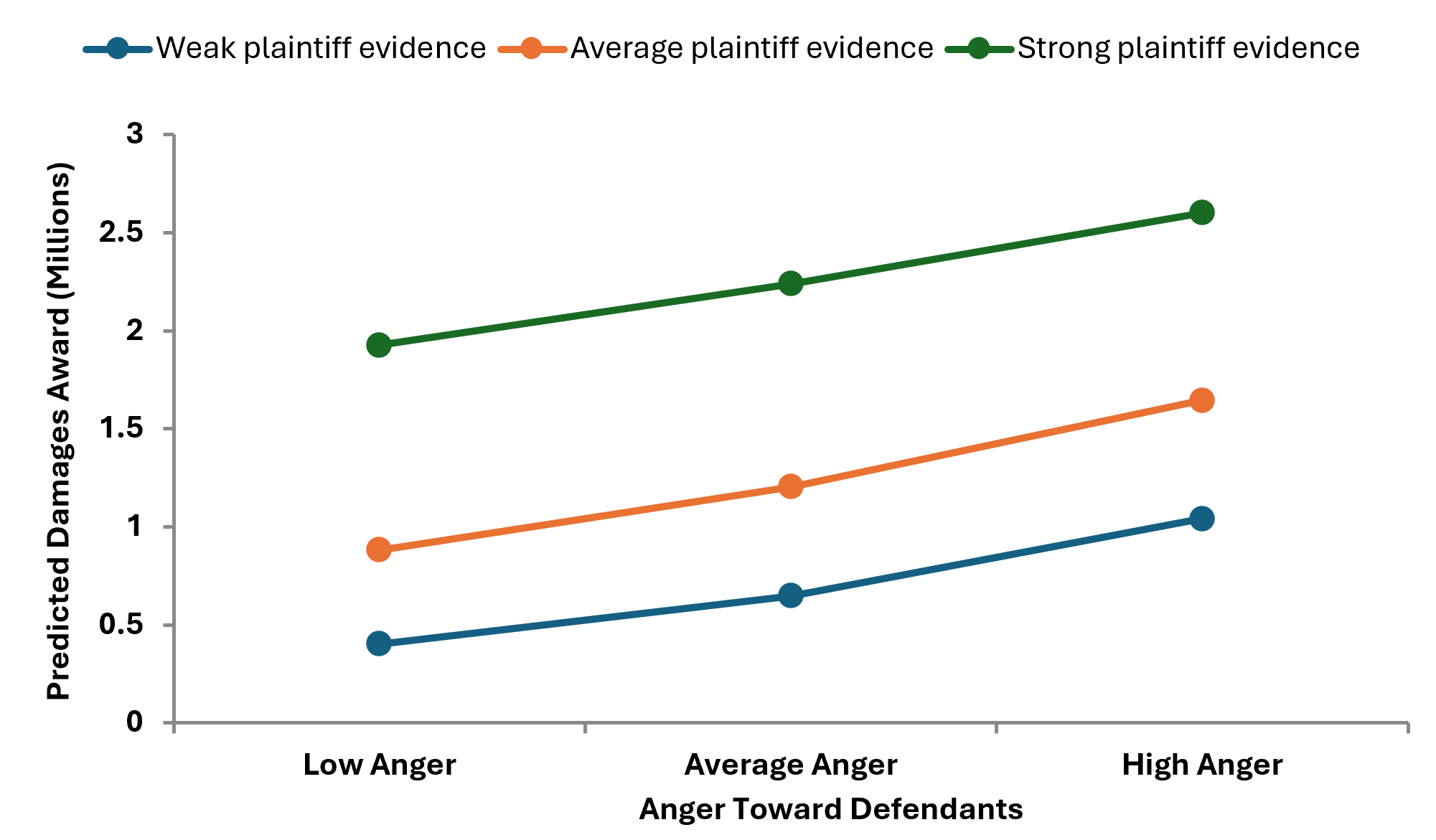
Note: Predicted damages are estimated from the log-transformed model and converted back to dollar values shown in millions.
In recent years, large civil verdicts have frequently been attributed to “angry jurors.” The underlying assumption is that jurors who become emotionally upset at defendants are primarily responsible for large verdicts. While this explanation is intuitively appealing, the findings from the current study suggest that reality is more nuanced.
The findings suggest that defense teams may benefit from shifting attention away from the simplistic goal of merely reducing juror anger and toward the broader factors that appear to drive outcomes: evidence quality, witness performance, credibility, and persuasive case presentation.
About the Authors:
Bill Kanasky Jr., Ph.D., is senior vice president of Courtroom Sciences, Inc. bkanasky@courtroomsciences.com
Steve Wood, Ph.D., is senior litigation consultant at Courtroom Sciences, Inc. swood@courtroomsciences.com